
Johnson County Arrest Warrants Explained
Before an arrest warrant issues in Johnson County, Tennessee law demands a complaint or affidavit with facts showing probable cause. A judge or magistrate weighs that information and picks the type of process the rules allow. The warrant then authorizes an arrest and a court date. That is different from a summons, which orders a person to appear without taking them into custody. Locally, General Sessions handles preliminary hearings, while felony cases can move up to Criminal Court. The Circuit Court Clerk keeps the court-side file for Criminal Court matters, and the Sheriff or another authorized officer serves the warrant.
Johnson County Arrest Process Uses Two Courts
A complaint often starts in General Sessions, where a preliminary hearing settles whether it holds. If a felony proceeds to indictment, the case shifts to the Circuit and Criminal Court track. Always ask whether the matter still sits in Sessions or has moved. The clerk holding the current file can change with that shift. Johnson County also belongs to the First Judicial District, alongside Carter, Unicoi, and Washington Counties. The county's administrative directory and the AOC district page help you map the correct court path, though no single office holds every warrant.
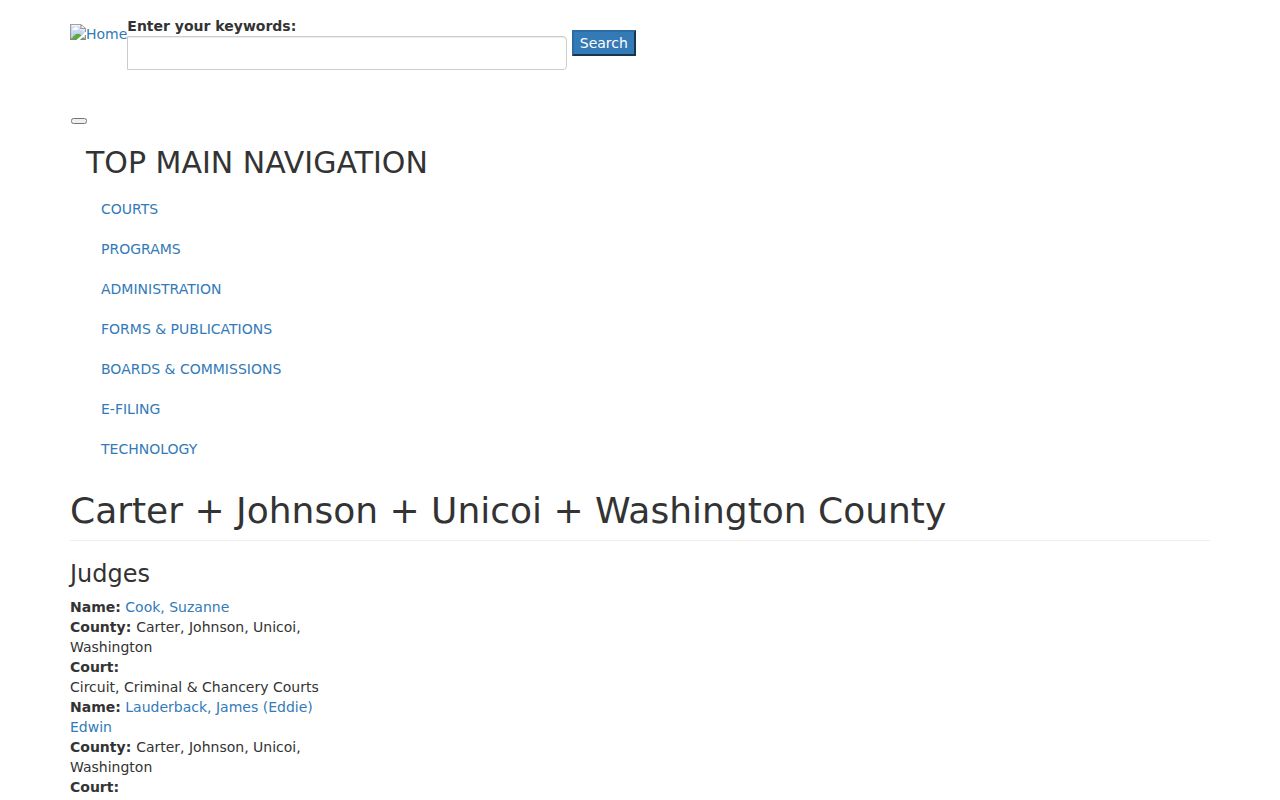
Use the district page to confirm which court covers a Johnson County case, then ask the clerk which file is active.
Inside a Johnson County Arrest Warrant
Johnson County publishes no sample arrest warrant and no local number format. Tennessee Rule 4 and state law describe the details a warrant record may carry. A clerk can identify the case and explain what you may inspect.
| Process number | No public sample found Ask whether the court assigned a number. |
|---|---|
| Complaint or affidavit | Written facts submitted for a probable-cause review. |
| Charge | The alleged offense or statute listed in the case file. |
| Issuing authority | The judge or magistrate who authorized the process. |
| Service return | A filed entry may note what happened when officers acted on it. |
| Bond or release | May appear in a later public docket event; no local schedule was found. |
Johnson County Warrant Affidavits May Be Restricted
In Johnson County, a docket can be public while an affidavit, attachment, or investigative detail stays sealed or redacted. Tennessee Supreme Court Rule 34 and the public-record statutes set those access limits. Ask the Circuit Court Clerk or the issuing clerk whether a filing can be inspected or whether a redacted copy exists. Juvenile court records carry special confidentiality rules, so never seek or publish juvenile identifying information. Keep one limit in mind: a denied or delayed copy request does not settle whether a warrant exists or what its status is. Tennessee Supreme Court Rule 34 explains the court-record access framework.
Serving Arrest Warrants in Johnson County
For service and custody questions in Johnson County, the Sheriff's Office is the direct contact. The Circuit Court Clerk can explain Criminal Court process, and General Sessions can route a misdemeanor or preliminary matter. Mountain City Police serve legal process for the town court under the municipal code. The county posts no warrant-unit page, no complete service roster, no surrender counter, and no bond-window hours. Call the Sheriff at 423-727-7761. Call the issuing court too, before you appear anywhere. Ask which agency holds the process and what location and time apply.
No Johnson County Arrest Warrant Portal
Johnson County offers no public arrest-warrant search. The Sheriff page lists contact details, though its linked external website has returned an error. The TBI Integrated Criminal Justice Portal serves agencies only, not the public. So call the Sheriff for service or custody confirmation, and call the issuing court for the docket, bond condition, or hearing date. Need a record copy? Request the existing document from whichever office holds it. Note one wrinkle: the countywide records policy excludes the Sheriff's Department, so ask that office for its own policy.
Comparing Arrest, Summons, and Bench Warrants
Each paper works differently in Johnson County. An arrest warrant follows probable-cause review, a summons directs a person to appear, and a bench warrant usually ties to a missed appearance or a court's direction. Read the process name and the issuing court before you respond. The bench warrant page covers the missed-date routes.
| Feature | Arrest Warrant | Summons | Bench Warrant |
|---|---|---|---|
| What it orders | Arrest and production before court | Appearance at a stated time and place | Arrest or other process after a court event |
| Basis | Complaint and probable cause | Process selected in place of custody | Missed date or failure to comply |
| Who issues it | Authorized judge or magistrate | Authority permitted by the rule | Judge handling the existing matter |
| Next step | Confirm court, bond, and counsel options | Appear as directed | Ask about recall, reset, or appearance |
Johnson County Warrant Bond Details Need Confirmation
No official Johnson County source publishes a current bond schedule, a jail bond-window location, hours, accepted payment types, or an online bond portal. Bond turns on the charge and the court's order. Ask whether bond has been set, where it can be posted, and whether another court date remains. Remember that posting bond addresses release conditions only; it does not dismiss the charge or erase the docket. Courthouse office hours tell you nothing about jail intake or bond hours. Confirm each instruction directly before you travel.
Federal Arrest Warrants in Johnson County
A federal arrest warrant moves through a court route separate from Johnson County's General Sessions or Circuit and Criminal Court. Federal cases here land in the Greeneville Division of the Eastern District of Tennessee. Docket searches run through PACER, and the U.S. Marshals Service handles federal warrant service. PACER may require registration and may charge fees. A docket entry alone is not live confirmation that process has been executed or recalled. Contact the federal court or the Marshals for the official answer, and never treat a county search result as a federal status check. Use the Eastern District location page, PACER, and U.S. Marshals district directory for their separate purposes.
If There's an Arrest Warrant for You
If you believe a Johnson County arrest warrant is active, pick up the phone before anything else. Call the court that most likely issued it, then the Sheriff. Ask the clerk a few direct things: is the warrant still active, has bond been set, and which office holds the current file. Find out too whether the judge wants a motion filed or an appearance scheduled. A lawyer can shape the next step, whether that means a voluntary surrender or a formal request to recall or quash the warrant. Johnson County publishes no walk-in surrender procedure, so the court's instructions are the ones to follow. Write down each call: the office, the date, and exactly what you were told. After any ruling, request a written docket entry or order for your own file, and if the case turns out to be federal, work through the Greeneville Division with federal counsel rather than assuming the county clerk keeps it.
Before appearing: Confirm current status and location with the court and Sheriff, then ask a lawyer about a safe, planned appearance.